Files vs. Databases vs. In-Memory State for Agent Context Storage
Each storage type solves a different memory problem, not one problem three ways.
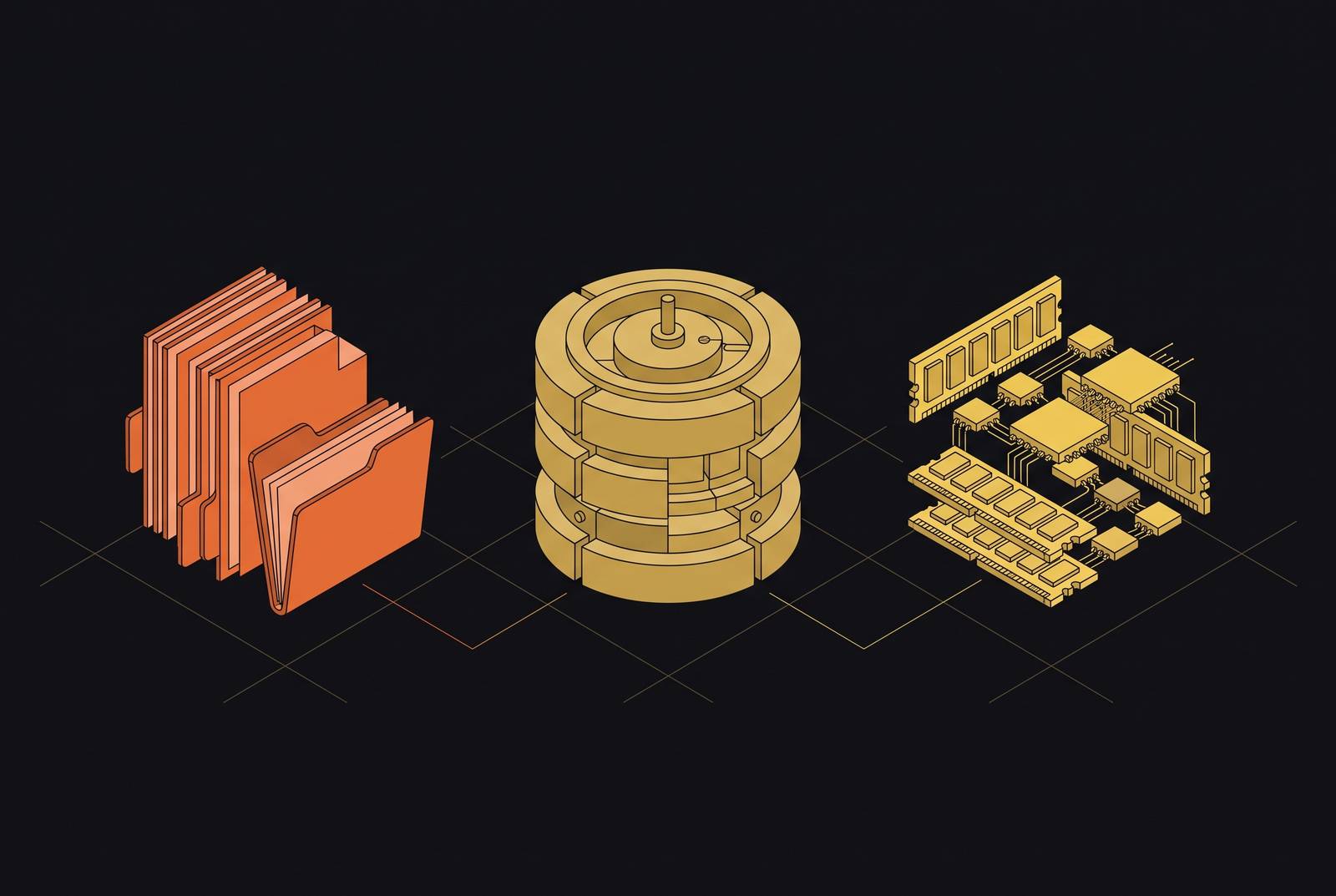
Files, databases, and in-memory caches all get pitched as "the answer" to agent memory, and that's the wrong question entirely. They're not competing solutions to one problem. Files vs. Databases vs. In-Memory State for Agent Context Storage.
Why the "pick a storage layer" question is three separate questions
A common failure mode in production agent builds is that someone picks a single storage primitive, usually whatever they already know, and stretches it across every context job the agent has. A vector database becomes the session cache. A flat file becomes the audit log. It works for a demo. It falls apart under real load.
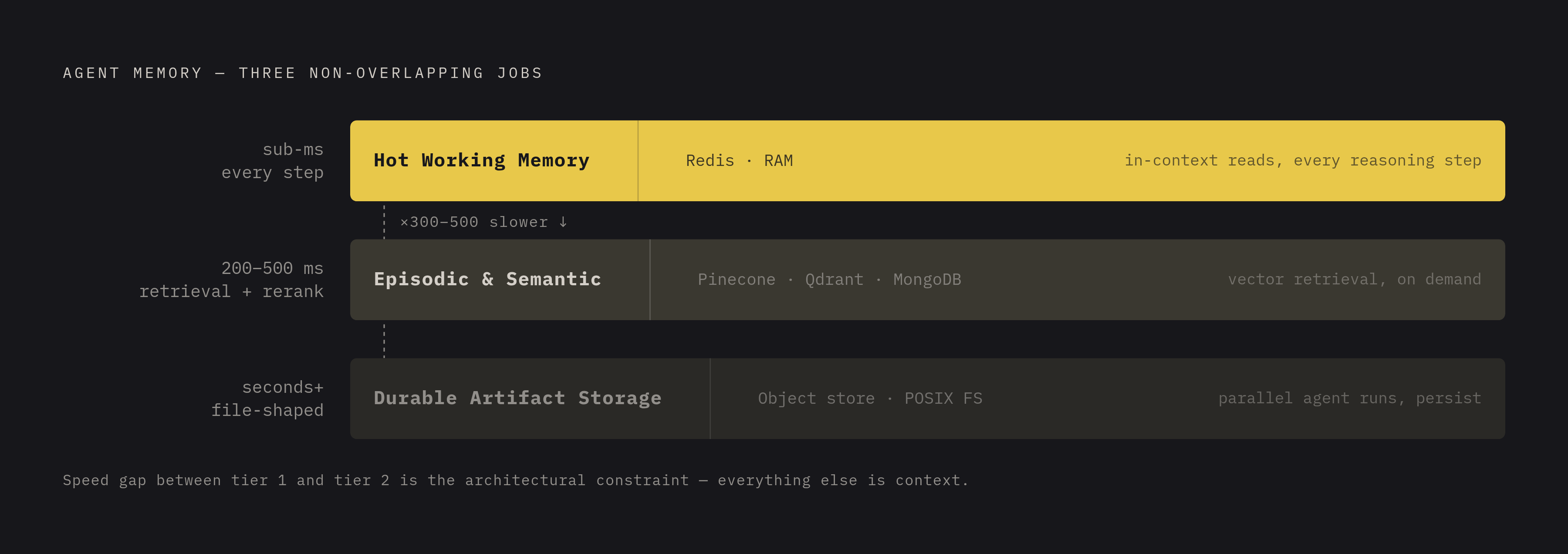
Agents actually need to handle three distinct jobs, and none of them look alike. There's hot working memory, the stuff the agent is actively chewing on this exact step, right now. There's episodic and semantic retrieval, the stuff it learned three sessions ago that needs to be retrieved again by meaning, not by exact match. And there's durable artifact storage, the files, checkpoints, and datasets the agent reads and writes across sessions and sometimes across parallel runs happening at the same time.
Research on agentic context management makes a sharper point here: agents don't usually fail because they can't reason. They fail because nobody managed what's actually sitting in the reasoning context, bloated conversation histories, oversized tool definitions, tool outputs that balloon past what anyone needed. Treating that as a pure storage-and-retrieval problem undersells it. It's a lifecycle. Context gets created, used, stale, and eventually needs to die, not just get stored somewhere and stay put.
By 2026, the architecture consensus caught up to this. Short-term session state, long-term episodic memory, semantic retrieval, and procedural context (the "how do I do this" knowledge) all degrade at different rates, and this difference in decay rates is what requires each to run on different infrastructure. What follows maps each storage type to the job it's actually good at, so the architecture gets assembled on purpose instead of by whatever the last engineer happened to reach for.
In-memory state: the right tier for the agent's working context
In-memory storage is built for one access pattern: short-term recall that has to load on every single step of the agent loop. Conversation turns, recent tool results, whatever half-formed reasoning the agent is holding onto right now. That data gets read constantly, and it has to come back fast.
Speed determines total task time directly, since a slow read on working memory is paid again on every reasoning step, and those milliseconds stack up across turns. Every reasoning step the agent takes hits the data layer again. A slow read on working memory doesn't cost you once, it costs you on every turn of a long task, and those milliseconds stack up across the whole run.
Redis is the clearest reference point for what this tier looks like done well. Its native structures, hashes, sorted sets, and streams map onto what an agent loop needs to track: task queues, locks, rate limits, coordination between sub-agents. Redis Flex blends RAM with SSD for memory that's rarely touched, cutting long-term memory costs by up to 80% without losing the retrieval path entirely Redis - Best databases for AI agent memory. It also plugs into LangChain, LangGraph, and more than 30 other agent frameworks, so it's rarely a standalone bet.
RAM is the right tier for anything hot. It is also the most expensive tier per gigabyte, and that math stops working once the working set gets big. So the dominant production pattern isn't "put everything in RAM," it's tiering: RAM for what's hot, SSD for what's warm, object storage for what's gone cold.
None of this solves durability, though, and it was never meant to. In-memory state is ephemeral on purpose. If you kill the process, it's gone. Anything that has to survive a crash, a session boundary, or a hand-off between parallel agents can't live in this tier alone. It has to graduate to something built for retrieval and retention, which is exactly where databases come in. Redis LangCache recognizes semantically equivalent queries and measured up to 73% lower LLM inference costs in benchmarks Redis - Best databases for AI agent memory.
Databases: matching the database type to the retrieval and retention job
Retrieval and memory get treated as synonyms, and they're not. A vector database answers "what looks similar to this?" An agent memory system has to answer a harder question: "what does this agent actually know, and is it still true?"
Databases in the agent stack are really covering three separate jobs. Semantic and episodic retrieval handles past conversations and knowledge surfaced by meaning. Stateful operational history covers task logs, user profiles, and compliance records, the stuff that needs transactional guarantees, not approximate answers. And semantic relationship traversal handles multi-hop reasoning across entities and facts, where you need to walk a chain of connections, not just find a nearby match.
Vector databases turn content into embeddings and index them for approximate nearest-neighbor search. They're fast, they parallelize well, and they handle messy unstructured text better than almost anything else. Three failure modes appear reliably in production: latency rises with corpus size, a consistency gap occurs in-database when multiple agents try to update the same record at once, and because there's no built-in concept of staleness, contradictory embeddings from different points in time sit there side by side with nothing flagging the conflict.
Pinecone handles the long-term retrieval slice well, fully managed, with namespace isolation per agent or tenant. It has no session or operational layer built in, though, so teams pair it with a cache and a separate operational store. Qdrant and Weaviate cover similar ground as open-source options, strong on hybrid retrieval and metadata filtering, but they generally need a relational database alongside them for episodic and procedural state. MongoDB's document model fits conversation logs, tool call metadata, and user profiles naturally, and it now supports native vector search plus hybrid retrieval through $rankFusion. Its disk-based reads accumulate latency over time, though, which makes it a solid durable archive that still needs a cache sitting in front of it for anything working-memory speed.
Graph databases earn their place for a specific reason: multi-hop reasoning across facts and entities needs actual graph structure. Vector similarity alone can't traverse a relationship chain, it can only tell you what's nearby.
On the relational side, PostgreSQL with the pgvector extension combines structured SQL with vector similarity in one system via extension, which makes it a practical choice for early-stage or moderate-scale agents. TiDB goes further, combining distributed SQL, vector search, HTAP, and ACID transactions in a single system, and it's built to support all four memory layers with the horizontal scale multi-agent workloads need. Distributed SQL systems broadly, TiDB, CockroachDB, Spanner, share that same profile: horizontal scale, strong ACID guarantees, and tenant isolation, all of which matter when many agents are writing state concurrently.
A few systems are trying to collapse this whole stack into one engine. Oracle's Unified Memory Core combines vector, graph, JSON, relational, spatial, and columnar data with transactional guarantees, a direct answer to the multi-hop reasoning gap that pure vector stores can't close. MinnsDB takes a similar swing, packaging a temporal knowledge graph, a vector store, a BM25 index, a claim store, temporal tables, and structured memory into a single Rust binary. An open format layer is forming as the structural base for all of it: hybrid data lakehouses built on Apache Parquet and Iceberg are becoming the structural base, with Iceberg emerging as something close to a standard for structured data across hybrid and multi-cloud setups.
Vector stores don't come with governance built in. No data lineage, no policy enforcement by tenant or role, no entity resolution. If "customer," "client," and "account" all mean the same thing in the data, nothing in the system knows that, and nobody finds out until two records disagree. Per atlan.com, vector database retrieval alone runs 200–500ms before the embedding model, reranking step, and LLM invocation (latency that compounds at scale) Mem0 - Your AI Agent's Memory Is Just a File? Cloudian - Best AI Storage Providers 2025 Atlan - Agentic AI Memory vs Vector Database. Relational and distributed SQL for stateful history.
Why flat files fail as agent memory past a small scale
Every agent developer ships the same thing first: a markdown or JSON file, MEMORY.md, CLAUDE.md,.cursorrules, read on startup, appended to during the session, written back when it's done. It's the hello-world of agent memory, and there's a reason it's everyone's first move: it works, right up until it doesn't.
Give files their due, because the zone where they work is real. Single user, single agent, roughly 200 static memories or fewer, and a flat file fits comfortably in a context window with zero infrastructure and full debuggability with plain old cat Mem0 - Your AI Agent's Memory Is Just a File? Cloudian - Best AI Storage Providers 2025 Atlan - Agentic AI Memory vs Vector Database. Static rules that never change, "always use TypeScript," house coding conventions, are read-only reference material that never needs an index or a conflict resolver. For prototyping, nothing beats the feedback loop: the agent should remember X, so you write X to a file, done. And plain text stays interpretable in a way a vector index never will. You can read a markdown file. You cannot casually read an embedding.
Past that zone, seven failure modes occur, reliably, in that order. The file grows past what fits in a context window, and now it's loaded wholesale instead of retrieved selectively. Grep can find a string, but grep can't reason about meaning. Files have no sense of time, so they don't know when a fact stopped being true. Concurrent writes race each other and silently drop data. Contradictions pile up with no resolution mechanism, so the model just guesses which version to believe. Access control gets rebuilt out of folder structure, which is not access control. And nothing in a flat file ever gets forgotten, so signal-to-noise only ever gets worse.
There's a useful historical echo here. The software industry went through this exact arc in the 1970s, moving off flat files and into databases, and it didn't happen because flat files stopped working. It happened because flat files stopped working at scale, under concurrency, once the questions being asked got harder than a single lookup. Same story, different decade. File-based agent memory isn't a wrong starting point. It's a wrong ending point for anything that will see real concurrency, facts that change, or more than one user.
Files as persistent artifact storage: the context job databases and caches are not built for
There's a separate job entirely that neither the database layer nor the in-memory layer is built to do: holding durable, file-shaped artifacts, training datasets, model checkpoints, code the agent writes and then runs, documents it reads and edits across sessions and sometimes across parallel runs happening at once.
This is a genuinely different access pattern from either of the layers above it. The data isn't rows, and it isn't embeddings, it's files, with all the POSIX plumbing that comes with that: atomic rename, file locking, memory-mapped access, sparse files, hard links. Agents need to read, write, and execute against a shared workspace, not load the whole thing into a context window and hope it fits. And more than one agent may need into that same workspace at the same time.
Object storage is what production systems use as the system of record here, mostly because it scales horizontally and handles massive parallel access without falling over. It natively supports multipart upload and parallel I/O, and a well-tuned cluster can sustain tens of gigabytes per second ingesting large datasets, outperforming legacy NAS setups doing the same job. The compute plane, the GPU cluster doing the actual training, and the data plane, the object storage feeding it, run as fully independent systems, which means a data team can add more training data without touching or pausing the GPU fleet at all.
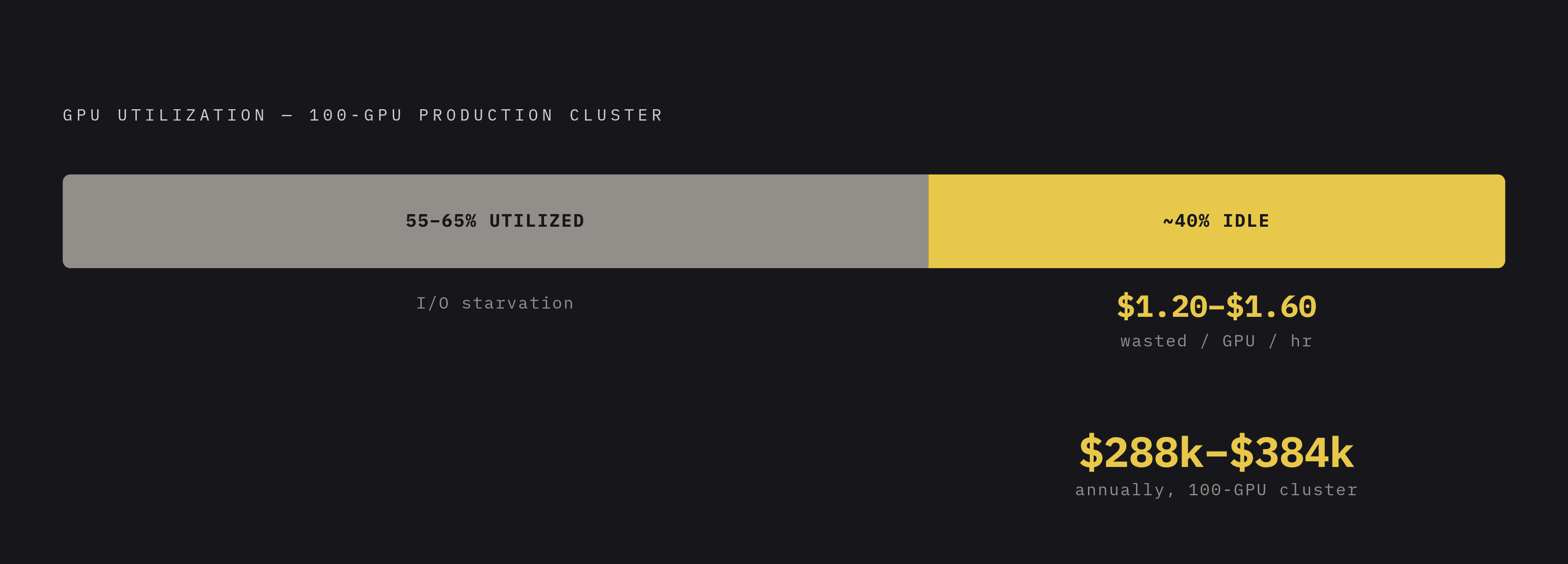
Object storage speaks HTTP and API calls, not POSIX. Agents and most existing code can't mount it as a filesystem without something translating in between. And that gap has a real cost. Traditional storage often delivers sequential read speeds well below what a single modern GPU can actually consume during training, which makes storage I/O the upstream cause of GPU starvation, not a side issue. Industry telemetry puts average GPU utilization in production AI environments around 55% to 65%, meaning GPUs sit waiting for data up to 40% of the time instead of doing the job they were bought for.
The fix that's emerged is a POSIX filesystem layer that mounts directly on top of the object storage bucket. Agents keep using the file interface they already know how to use, the bucket remains the actual source of truth, and there's no migration, no ETL step, no code rewrite required. The filesystem-as-interface idea earns real weight here: frontier models get trained heavily on bash and file manipulation, so an agent that can run shell commands straight against a persistent filesystem doesn't need custom tooling bolted on just to touch unstructured data. Pairing that filesystem with serverless compute that accepts bash commands and hands back results lets agents read, write, and execute code against persistent storage without a separate sandbox environment in the loop. Provisioning matters too: nobody knows how big an agent's workspace will get ahead of time, so storage that's metered on actual use avoids the overflow or half-empty capacity that comes with storage that gets pre-allocated.
The data movement problem that sits between these layers
None of this matters in isolation, because the layers have to hand data to each other, and that hand-off is where the money actually leaks out.
The GPU starvation numbers make the cost concrete. That's not a performance footnote. That's a line item. And the bottleneck isn't rare: more than half of organizations report data and storage bottlenecks limiting AI performance, and 57% say their data isn't even AI-ready in the first place.
Splitting compute and storage into separate, independently scaling systems is supposed to fix scaling headaches, and it does. Solve one bottleneck, open a door for another, unless someone's watching the seam.
Training and inference don't even want the same thing from storage. Training needs sustained, high-throughput sequential reads to keep checkpoint bandwidth flowing. Inference wants the opposite profile: high IOPS and latency low enough that nobody notices it SoftwareSeni - AI Training and Inference Storage Performance Requirements. These are different jobs, and they call for different tiers deployed side by side, not one tier trying to do both. CoreWeave announced General Availability of CoreWeave AI Object Storage at NVIDIA GTC in March 2025, managed object storage purpose-built for AI training and inference at scale.
The lesson for anyone building this stack: building custom data-movement pipelines to feed GPUs is wasted engineering work; the goal is eliminating the movement, not optimizing it, with data reachable at the layer that needs it without a separate pipeline stage. Vendors are already racing toward that. Other vendors have pushed in the same direction with products aimed at bridging object storage and low-latency agent context, evidence that this seam between layers is exactly where the next round of infrastructure competition is happening. Per hammerspace.com, when storage cannot saturate a modern GPU cluster, approximately $1.20–$1.60 per GPU per hour (or $288,000–$384,000 annually for a 100-GPU cluster) is wasted on idle cycles, while the $30,000 figure refers to the purchase price of a single H100 GPU, not annualized waste per node (a financial consequence of I/O starvation, not just a performance footnote). Per a CNCF white paper published in July 2026, compute-storage disaggregation scales efficiently but can introduce heavy API call overhead and low GPU utilization, so the very architecture that solves the scaling problem can reintroduce the I/O problem if data movement is not managed.
Sources
- Agentic AI Memory vs Vector Database: Architecture Guide 2026
- Best Database for AI Agents (2026): Memory, State & RAG Guide
- Best databases for AI agent memory: a 2026 comparison
- Your AI Agent's Memory Is Just a File? That's the Problem
- Agentic Context Management: Solving Agent Memory and Cost by Treating Them as Lifecycle and Architecture Problems
- Filesystem vs. Database for Agent Context Memory — A Comparison | by Anders Swanson | Oracle Developers | Jan, 2026 | Medium
- Unified Memory Core for AI Agents with Oracle AI Database
- Architectural Design Decisions in AI Agent Harnesses