Iterative Context Discovery vs. Front Loaded Prompt Injection
Agents work better when they pull context on demand instead of loading everything upfront.
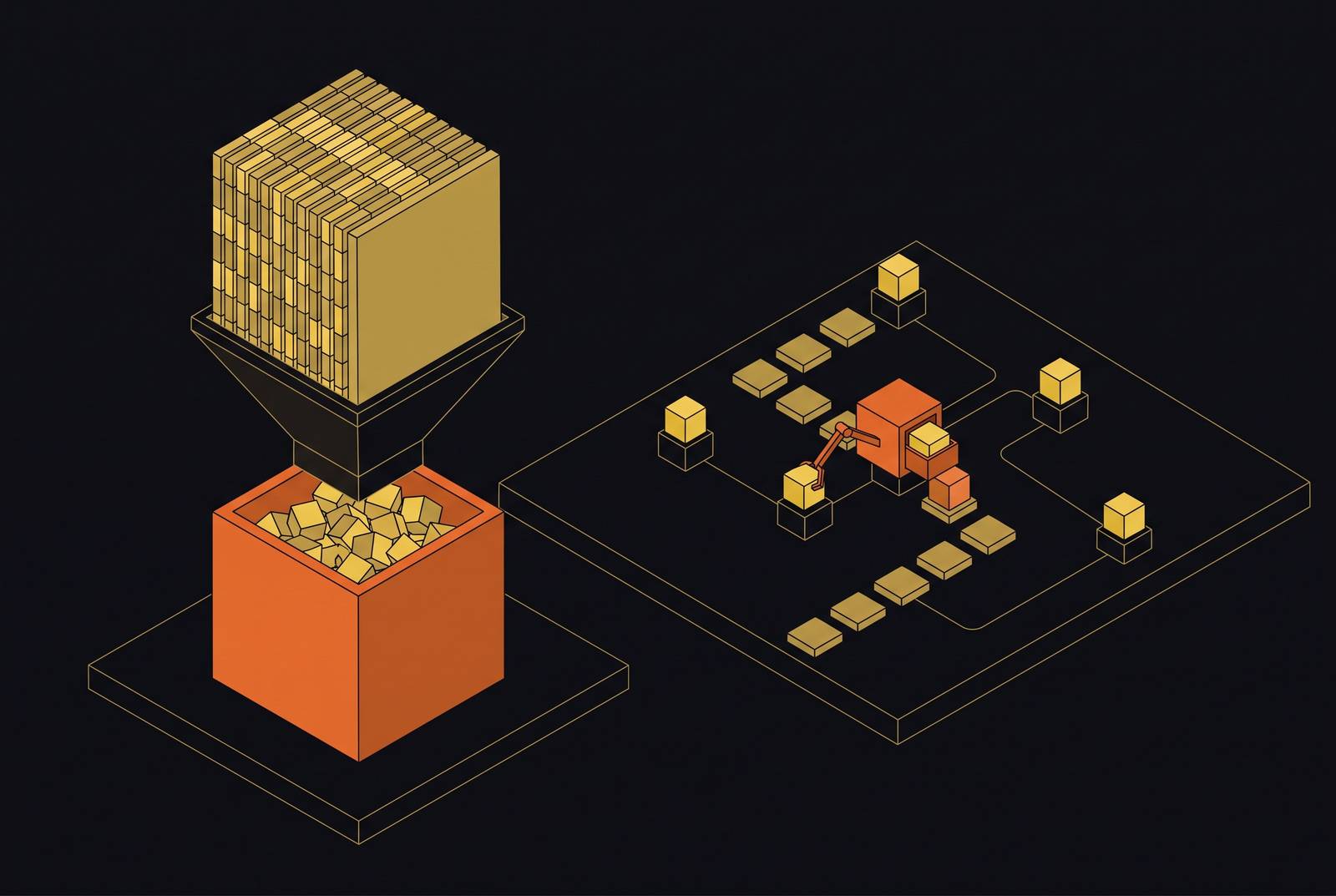
Front-loading a prompt means stuffing every rule, fact, and constraint into the system message before the model does anything, on the theory that more upfront material equals fewer mistakes later. Iterative context discovery flips that: the agent pulls what it needs, when it needs it, the way a person actually works. This piece walks through why the industry is quietly ditching the first approach for the second, and what that means for anyone building agents that run longer than a single chat turn. Iterative Context Discovery vs. Front Loaded Prompt Injection.
Why the prompt became the wrong unit of design
The earliest wave of LLM apps treated the prompt like ad copy. Get the wording just right, bolt on a few examples, tweak a phrase here, tweak it there, and hope the output improves. That made sense back when tasks were one-and-done and the source material was small enough to memorize. Nobody was asking a model to run a multi-day research task or manage a codebase across sessions.
Then, in early 2026, something telling happened: Neo4j, Elastic, ByteByteGo, and Firecrawl all put out guides on "context engineering," not prompt engineering, and they did it independently of each other. That's not a coincidence, and it's not a rebrand for the sake of a new buzzword. It's a signal that the center of gravity moved. The real question stopped being "what words do I use" and became "what information does the model actually need, where does it live, and when should it show up". Once you start asking it that way, front-loading starts to look like answering a question nobody asked yet.
What front-loading context means in practice
Front-loading means jamming everything, rules, persona, knowledge base, edge-case constraints, into one big system prompt before the model starts reasoning. The appeal is obvious enough: one document to maintain, and a real financial incentive to boot. Anthropic charges cache reads at a 90% discount off base input price, and Google offers the same 10%-of-standard-rate deal for Gemini 2.5 and up. Cache once, reuse constantly, save money. Simple, right?
Except the caching discount comes with a catch that trips people up constantly: the static content has to sit at the very front of the prompt and stay byte-for-byte identical across requests. A 2026 study found that changing one token in that prefix can make the cache hit rate fall to zero for every subsequent request in the session. That's a significant inefficiency. That's the entire discount evaporating because someone added a comma.
There's a real ceiling where front-loading actually wins, to be fair. Cache-Augmented Generation, loading the whole corpus rather than retrieving pieces of it, can match or beat retrieval on speed and accuracy when the corpus fits within roughly 200K–1M tokens, because the model sees relationships that chunking destroys. Past that window, though, front-loading is a wall. It's a wall.
The structural cost of carrying too much context
Poor context management eats 60 to 70 percent of total AI spend. Not a rounding error. A majority of the bill.
The reason this catches people off guard is a math problem hiding in plain sight. Context doesn't grow linearly with each turn of a conversation, it compounds. Teams that model per-turn costs independently, rather than accounting for the compound growth of context across turns, end up underestimating multi-step agentic workflows by a factor of 3x to 5x. A budget forecast built on that compounding stays accurate; one that ignores it becomes a budget disaster.
And it's not theoretical. Agents left running continuously routinely balloon to 80,000 to 120,000 tokens of context within a matter of weeks. Meanwhile, the context windows vendors advertise aren't the windows you actually get to use. Models start losing the plot well before hitting their stated limit, with usable capacity landing around 60 to 70 percent of the marketed figure. Every team running frontier models in production gets surprised by this at least once. Consider it a rite of passage.
Where agent failures originate
Most of the time, when an agent gets something wrong, it's not the model's fault. It's a context failure dressed up as a model failure. The agent hallucinates because nobody handed it the right fact. It gives you last month's answer because its knowledge got frozen the moment someone wrote the prompt.
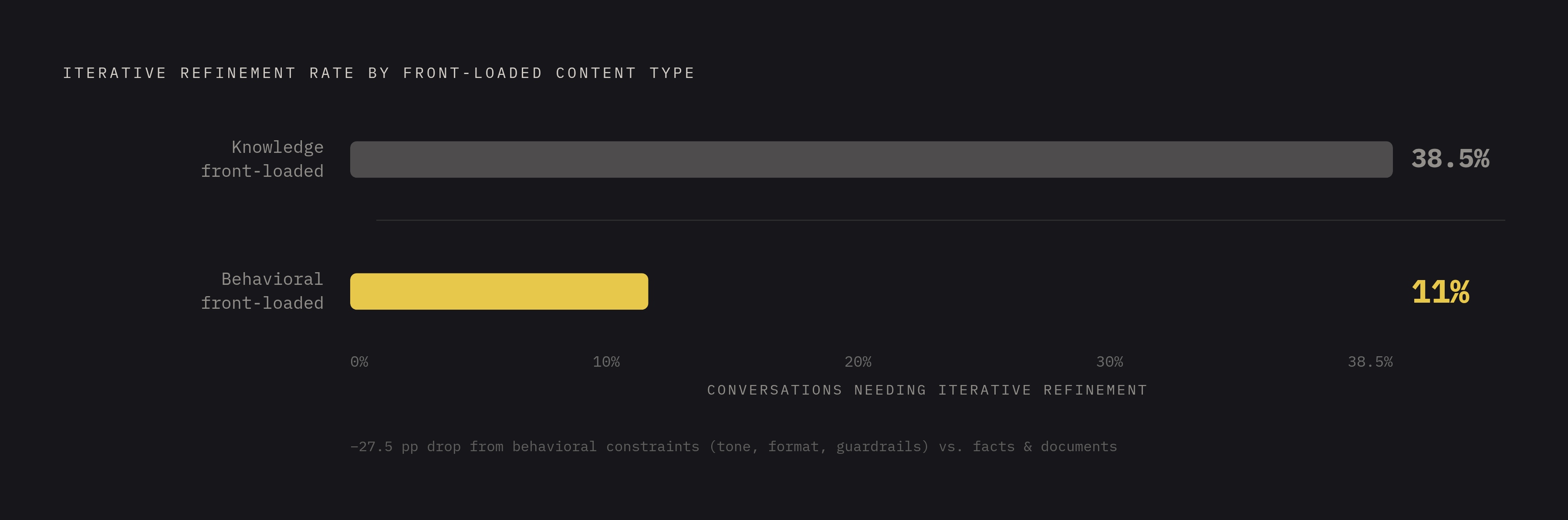
The numbers back this up in an oddly precise way. In 2026, 38.5 percent of AI conversations involve some kind of iterative refinement: the first shot missed. But look at who's missing: prompt engineers average 1.3 attempts to land something usable, while unprepared users average 4.2 attempts on the same kind of task. Same model. Wildly different outcomes. The gap sits entirely in how context gets structured, not in the model itself.
Anything time-sensitive baked into a system prompt starts rotting the moment it's written. A nuance from the February 2026 RCCF study is worth noting here, though. When teams front-loaded behavioral constraints, tone, format, guardrails, rather than knowledge content, the share of conversations needing iterative refinement dropped from 38.5 percent all the way to 11 percent. That's a big deal, because it means the villain here is front-loading the wrong thing from the start. It's front-loading the wrong category of thing. Structure travels well. Facts expire.
How iterative context discovery works
Dynamic context is whatever gets fetched or assembled the moment it's actually needed, based on the specific task in front of the agent, not on what someone guessed it might need six months earlier at design time. The agent isn't handed a folder of everything up front. It goes and gets things: reads a file, queries a database, calls a tool, and only accumulates what the current reasoning step actually requires.
That assembly can happen fresh at every single step. Which document to pull, how much history to include, which tool to call, none of that gets locked in at design time anymore. Those become runtime decisions. It's the same instinct a competent analyst uses on the job: nobody reads the entire filing cabinet before answering a question. You pull the one folder you need, when you need it, and you leave the rest of the cabinet closed.
The measurable case for pulling context as needed
The numbers make the case hard to argue with. That's a substantial efficiency gain. That's a different order of magnitude.
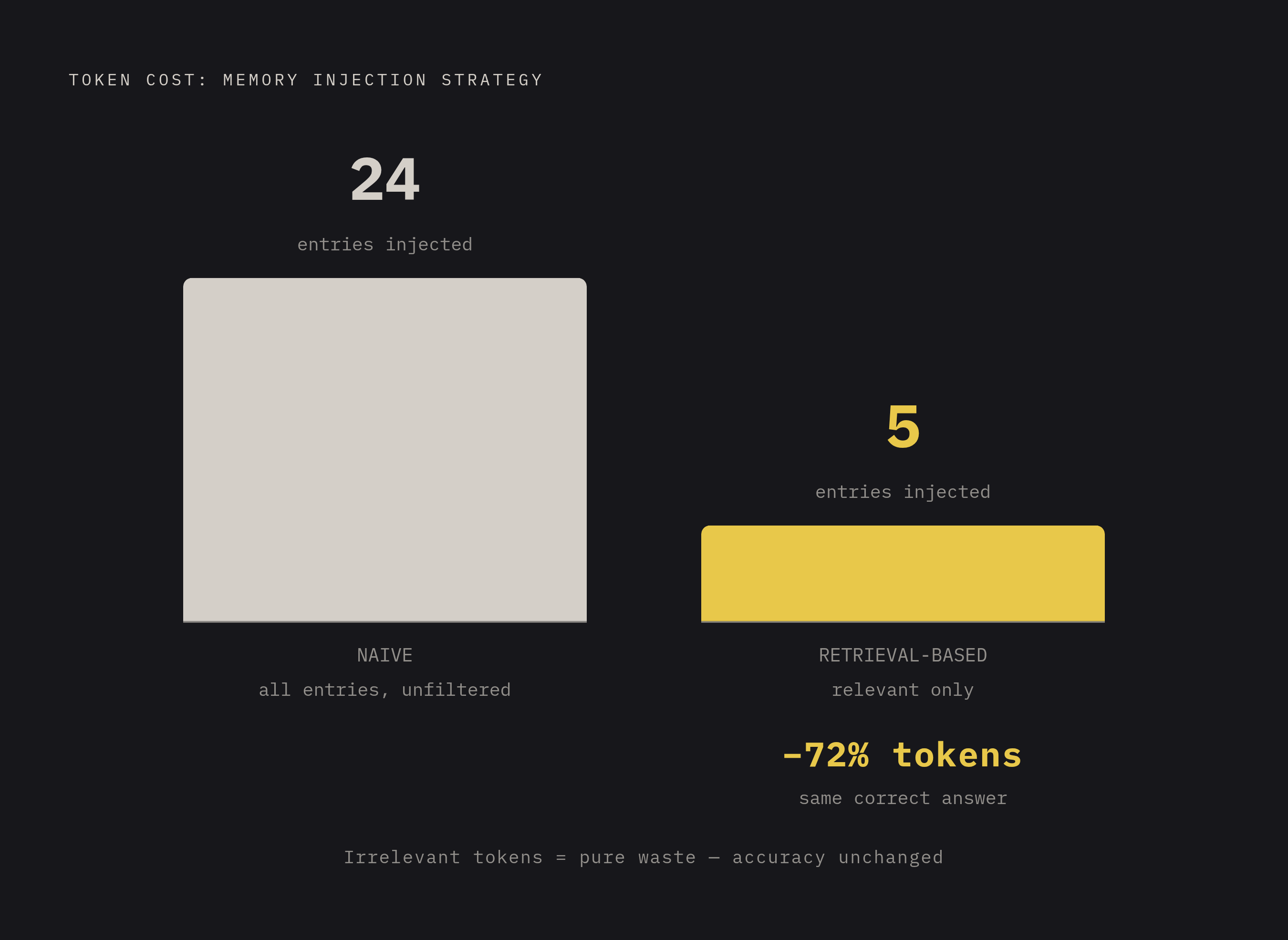
A more controlled test makes the same point with cleaner numbers. Naive memory injection dumped all 24 raw memory entries into the call. Retrieval-based injection sent 5 entries, the relevant ones. Token use dropped 72 percent, and both approaches landed the same correct answer. The savings didn't cost anything in recall. The irrelevant context wasn't traded away for something better, it just wasn't there in the first place, and the answer came out fine anyway.
Relevance also does something to accuracy that's easy to undersell. Dynamic context tuning cuts hallucinations by 37 percent compared to static baselines on tested benchmarks. Less noise, fewer wrong turns. That tracks. Replacing a 30,000-token static context with semantically relevant chunks of 300–800 tokens represents a reduction of more than 98% for knowledge retrieval tasks.
What persistent, filesystem-level context enables that session-scoped retrieval cannot
Retrieval solves the problem for one call, one question, one moment. It doesn't solve the problem of what happens tomorrow. Every new session starts from zero, and the agent has to re-derive context it already worked through the day before. That's expensive in a way that's easy to miss because it doesn't cause a single bad answer, it causes wasted cycles, over and over.
A persistent workspace changes the whole unit of measurement. Instead of asking "what gets stuffed into this prompt," the question becomes "what has the agent already built, and can it find its way back to it." That's a working directory, not a query result. Filesystem semantics matter here in a very literal sense: writing intermediate findings to disk, organizing them into folders, using atomic operations so nothing gets half-written, picking up a task exactly where the last session left off. None of that requires bloating a single prompt.
And when multiple agents are working the same data at once, a shared, consistent view stops being a nice-to-have. A filesystem mounted by several processes simultaneously handles that naturally. Session-scoped retrieval, by contrast, doesn't really have an answer for it, because there's no shared "it" to retrieve from.
The security exposure that bloated, static context creates
Big static system prompts aren't just inefficient, they're a target. Cram behavioral rules, credentials, and tool metadata into one persistent block that gets processed on every single call, and anyone looking to attack the system knows exactly where to aim.
Researchers from Shanghai Jiao Tong University and HKU built something called IterInject that exploits the agent's reliance on retrieved external content, where adversarial payloads embedded in documents, emails, or web pages hijack agent behavior through indirect prompt injection. Adversarial instructions get buried inside documents, emails, or web pages, and the agent, trusting what it retrieves, gets hijacked through indirect prompt injection. The attack adapts as it goes, which is the uncomfortable part.
Separately, a red-teaming study looked at six coding agents in active use, Cursor, Claude Code, Copilot, Windsurf, Cline, and Trae, and found something called ToolLeak. There's a gap between how a model generates normal chat and how it generates arguments for a tool call, and that gap causes it to copy hidden context, system prompts, tool metadata, straight into the tool-call arguments, effectively leaking it out. Combining that leaked context with a two-channel prompt injection, the same study achieved remote code execution on all six agents. All six. Not a hypothetical vulnerability sitting in a lab somewhere.
How the 2026 hybrid model works in practice
The consensus forming in 2026 is a division of labor." It's a division of labor. Static context handles governance: the stuff that shouldn't move around, tone, persona, hard constraints, output format, guardrails. Dynamic context handles everything that's alive: knowledge, procedure, policy, anything that changes by the week or the hour or doesn't fit in cache to begin with.
The mechanism doing the routing is usually some version of adaptive retrieval. A classifier looks at each incoming request and decides which pipeline it belongs in. If the corpus fits and the content's stable, use long-context plus caching. If it doesn't, pull from a retrieval layer instead. Neither approach wins by itself. They're tools for different jobs, and the smart move is picking the right one per request instead of betting everything on one architecture.
The storage and infrastructure that iterative discovery depends on
None of this works if the plumbing underneath is slow. An agent that has to wait on sluggish storage every time it needs a fact will either give up and batch-load everything upfront, the exact anti-pattern this whole shift is trying to escape, or it'll just stall out.
The gap here is measurable and it's not small. Average GPU utilization in production AI environments is around 55 to 65 percent, and the upstream cause traces back to data-pipeline I/O. Traditional storage delivers roughly 1 to 5 GB/s of sequential read. Do that math and the bottleneck isn't subtle, it's a pipe that's roughly a tenth the width it needs to be.
More than half of organizations report storage bottlenecks limiting their AI performance, and 57 percent say their data isn't even AI-ready in the first place. Failing to discover context and lacking data infrastructure amount to the same failure, just showing up at different layers of the stack. Agent workloads also want something different from what training workloads want. Low-latency random access, filesystem semantics that let an agent write and read its own intermediate files, elastic capacity since nobody knows in advance whether a task needs a megabyte or a gigabyte of working context, and the ability for parallel agent runs to hit the same data at once without stepping on each other.
What to change, and in what order
Start with the system prompt. Go through it line by line and flag anything that's a fact, a procedure, or a document reference rather than a behavioral rule, anything that could go stale next month belongs somewhere retrievable, not baked into the static block. That single audit tends to reveal just how much of a "carefully engineered" prompt is actually just outdated trivia wearing a system-prompt costume.
From there, the order matters less than the direction. Move knowledge into retrievable stores. Keep governance, tone, format, guardrails, in the static layer where caching still pays off. Build (or buy into) storage that can handle low-latency random access and elastic, on-demand capacity, because none of the retrieval logic matters if the fetch itself is the slow part. And treat security as part of the design from day one, not an afterthought bolted on after a red team finds the hole. Front-loading isn't going away entirely, it still earns its keep for stable behavioral rules and small, static corpora. But treating it as the default for everything is the mistake the whole field spent the last year correcting. More than 50% of organizations report data and storage bottlenecks that limit AI performance and scalability https://www.min.io/blog/ai-storage-architecture-bottleneck-2026. 57% of enterprises say their data is not AI-ready https://www.min.io/blog/ai-storage-architecture-bottleneck-2026. Over 70% of enterprise generative AI initiatives have been quietly stalled, scaled back, or abandoned entirely as of 2026 https://www.ness.com/blog/data-modernization-in-cloud/. Traditional storage systems deliver sequential read speeds of 1–5 GB/s https://hammerspace.com/accelerating-ai-workloads-through-intelligent-data-orchestration/. A single modern GPU can consume data at 15–30 GB/s during training https://hammerspace.com/accelerating-ai-workloads-through-intelligent-data-orchestration/. China grabs 11% of the global prompt engineering market share https://ucstrategies.com/news/prompt-engineering-best-practices-in-2026-the-ultimate-guide-to-better-ai-prompts/. When humans tackle complex tasks solo, they are averaging 3.55 hours https://ucstrategies.com/news/prompt-engineering-best-practices-in-2026-the-ultimate-guide-to-better-ai-prompts/. When humans use AI with proper prompting, task completion time drops to 18.7 minutes https://ucstrategies.com/news/prompt-engineering-best-practices-in-2026-the-ultimate-guide-to-better-ai-prompts/. Using AI with proper prompting achieves an 11.4x speedup compared to humans working solo https://ucstrategies.com/news/prompt-engineering-best-practices-in-2026-the-ultimate-guide-to-better-ai-prompts/. Most people are experiencing a 6.5x latency penalty by using generative workflows when they need deterministic ones https://ucstrategies.com/news/prompt-engineering-best-practices-in-2026-the-ultimate-guide-to-better-ai-prompts/. Human + AI with poor prompts completes tasks in 47 minutes with a 34.8% error rate https://ucstrategies.com/news/prompt-engineering-best-practices-in-2026-the-ultimate-guide-to-better-ai-prompts/. Human + AI with poor prompts has a 34.8% error rate https://ucstrategies.com/news/prompt-engineering-best-practices-in-2026-the-ultimate-guide-to-better-ai-prompts/. Human solo work has a 12.3% error rate https://ucstrategies.com/news/prompt-engineering-best-practices-in-2026-the-ultimate-guide-to-better-ai-prompts/. Human + AI with optimized prompts has an 8.2% error rate https://ucstrategies.com/news/prompt-engineering-best-practices-in-2026-the-ultimate-guide-to-better-ai-prompts/. 38.5% of AI conversations in 2026 involve iterative refinement https://ucstrategies.com/news/prompt-engineering-best-practices-in-2026-the-ultimate-guide-to-better-ai-prompts/. Product managers needed an average of 4.2 attempts to get something usable when writing launch announcements https://ucstrategies.com/news/prompt-engineering-best-practices-in-2026-the-ultimate-guide-to-better-ai-prompts/. Prompt engineers needed only 1.3 attempts to get something usable https://ucstrategies.com/news/prompt-engineering-best-practices-in-2026-the-ultimate-guide-to-better-ai-prompts/.