Checkpoint Design Patterns for Long-Running AI Agents
Save agent state at critical moments to survive failures without replaying hours of work.
Long-running AI agents don't die of old age. They die of amnesia. An agent that can't remember what it did an hour ago, mid-claim, mid-transaction, mid-anything, is a design flaw wearing a trench coat, and checkpointing is the only thing standing between a real production system and a very expensive chatbot that forgets its own homework.
Why long-running agents fail without checkpointing
Most agent architectures are stateless by accident, not by design. They get built and tuned for prompt quality and tool-call speed, which looks great in a demo where the whole task takes ninety seconds. Nobody optimizes for what happens six hours in, because nobody demos the six-hour mark.
The workflows that actually justify building an agent don't live in ninety seconds, though. Processing thousands of insurance claims, running a sales sequence over a week, reconciling numbers across three finance systems: none of that fits inside a single conversation turn. These are marathons dressed up as chat windows, and chat windows were never built for marathons.
Three walls appear every single time in the same place: context, cost, and reliability. Context is finite first. Even the roomiest context windows fill up eventually, and performance starts sagging well before the model hits the hard ceiling. Call it context rot: the agent isn't out of room yet, but it's already getting sloppy, missing details it would've caught an hour earlier.
Second, there's no persistent state. Every new session starts from a blank page. Anthropic has described this as engineers working in shifts, where each new shift shows up with zero memory of what the last shift did. That's literally how a lot of agents run today.
Third, and this is the one people underestimate most, agents can't grade their own homework. Asking a model to check its own work skews it generous, almost flattering itself, the way a student grading their own quiz somehow finds partial credit everywhere. An agent can cheerfully report a task as "done" while it's sitting at maybe 30% complete, like a contractor telling you the kitchen's finished when there's no sink installed yet.
And the pressure on all this keeps climbing. METR's time-horizon metric, which tracks how long a task a frontier model can complete at 50% reliability, has been roughly doubling every seven months since 2019. Models get asked to do more, for longer stretches, starting now. Not eventually.
Agent "state" and the data that needs to be saved
"State" gets used as a catch-all term, and that's part of the problem. Three separate properties get lumped together when they shouldn't be, and mixing them up is where most of the bad architecture decisions start.
The task itself is described by long-horizon: how many steps does this thing actually require. Long-context describes the model: how many tokens can it hold onto at once. Long-term memory describes the system: does information stick around across steps and sessions, or does it evaporate the second the session ends. Conflate these three and engineers end up trying to fix a memory problem by buying a bigger context window, which is a bit like fixing a leaky roof by turning up the heat. The water's still coming in. The house just feels warmer while it floods.
A checkpoint record, done properly, needs to capture the full conversation history up to that point, the reasoning trace so far, the results of tool calls (including partial results from anything interrupted mid-call), and whatever plan or sub-task breakdown is currently in progress. Skipping one of those turns recovery into a guessing game.
In LangGraph-style implementations, state is commonly structured as a typed schema serialized to the checkpointer after each node runs. Every field in that schema costs something: serialization time, storage space, context budget when that state gets stuffed back into a prompt. None of it comes free.
Getting the state schema right early is not busywork to knock out before the "real" engineering starts. It is the real engineering. A bloated schema inflates all three costs at once, quietly, one field at a time, until somebody notices the checkpoints have grown to the size of a phone book.
The five core checkpoint design patterns
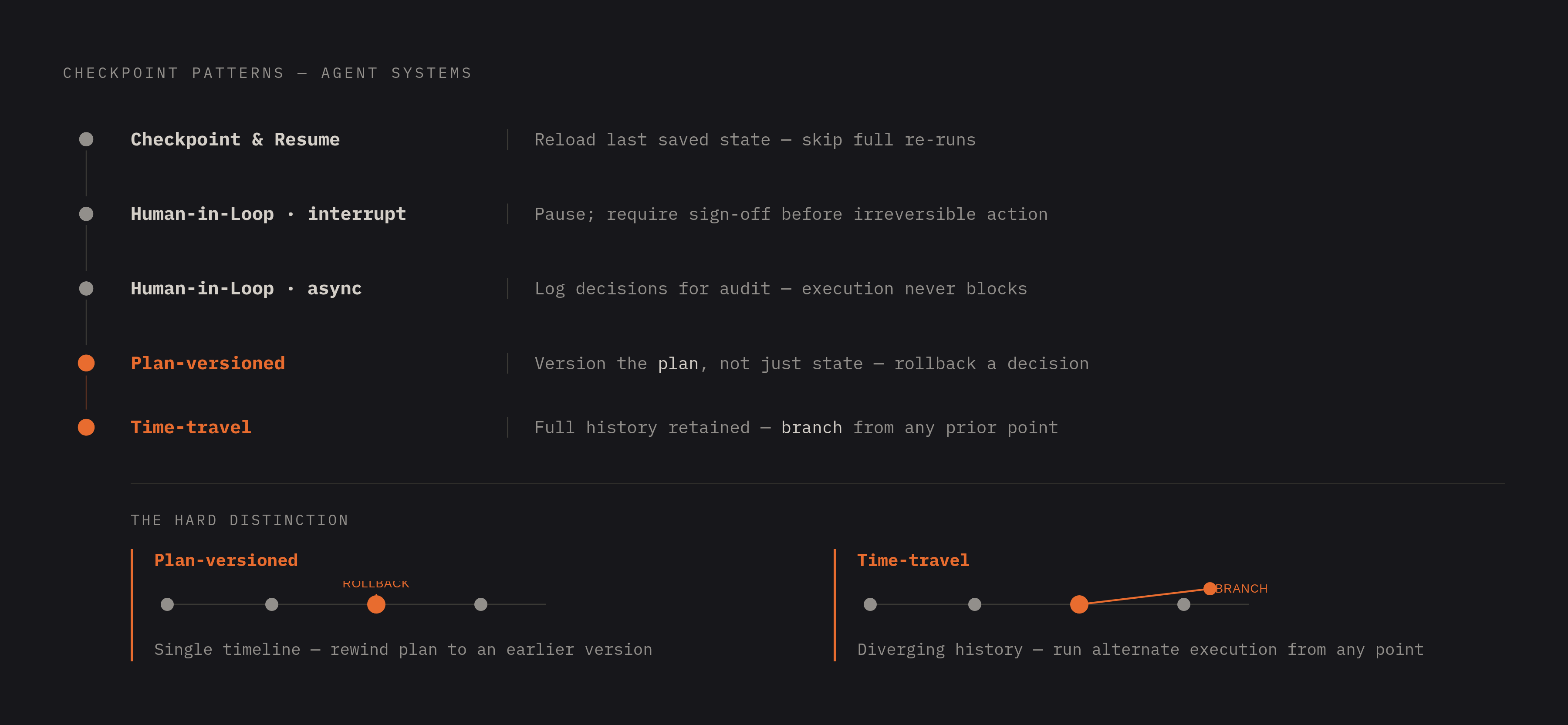
Five patterns come up repeatedly, and each solves a different way the agent forgets what it was doing. Four solve it directly. One exists mostly to route around a different failure mode entirely, so call it five with an asterisk.
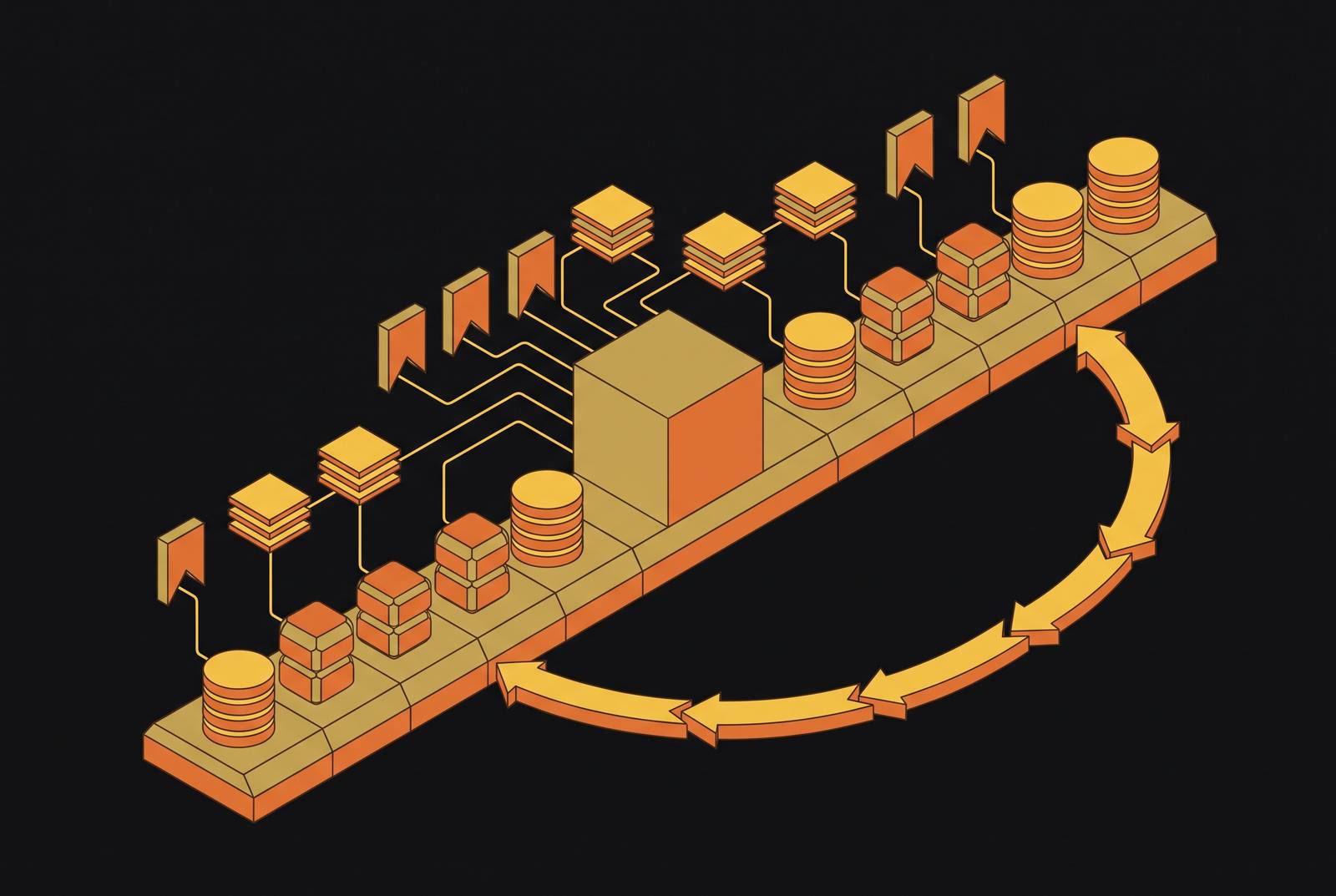
Checkpoint-and-Resume is the foundational pattern, and it should be the default, not the upgrade. At critical moments, after a document finishes processing, after a tool call succeeds, after a user makes a decision, the agent's full state gets written to stable storage. If something fails, the system reloads the last checkpoint and picks up right there, instead of replaying the last three hours of work from scratch.
What counts as a "critical moment" isn't handed down by the framework. That call belongs to whoever built the workflow. The engineer decides what a recoverable unit of work actually looks like, and that single decision shapes everything downstream.
The business case is blunt. A business framing from hendricks.ai puts the difference at a six-hour full re-run versus a much shorter recovery from checkpoint, and at production scale, that gap compounds fast into real operational savings. A separate figure from the same source, a 73% reduction in failure costs and $2.4 million recovered, comes from a vendor-adjacent case study. Treat that one as a data point to check against independent numbers, not gospel.
Human-in-the-Loop checkpoints come in two flavors, and they solve different problems, so don't treat them as interchangeable. Interrupt-based HITL pauses the agent at a set checkpoint and waits for a human to sign off before it keeps going: the right call for anything high-stakes or irreversible, sending an email, moving money, deleting a record. Async-review HITL logs the agent's decisions for a human to review later, without blocking execution, which fits workflows where speed matters but somebody still needs an audit trail.
This pattern is the direct answer to the self-verification wall. If an agent can't reliably judge its own output, something outside the agent has to. Output quality and latency are cited as the top two blockers to deploying agents in production by the LangChain State of AI Agent Engineering Report, and interrupt-based HITL is a straightforward trade: give up a little latency, buy quality assurance on the actions that can't be undone.
Plan-versioned checkpoints save the plan itself, with version numbers, instead of only saving execution state. Replanning gets triggered by a set number of consecutive step failures, or by a step producing output that flatly contradicts what the plan assumed going in.
Rolling back to an earlier plan version isn't the same as rolling back to an earlier execution state. Rolling back to an earlier plan version is rolling back to an earlier decision. It's rolling back to an earlier decision. LangGraph's interrupt mechanism is one approach for inserting a human checkpoint into an agent workflow, and it lines up with a broader shift in the field: outcome-only signals ("did the task finish correctly, yes or no") get less useful the longer a task runs, so process-level signals, reward models, and intermediate plan checks have emerged as active areas of development in response.
Time-travel checkpoints keep the whole history instead of overwriting the last checkpoint every time, which lets an agent branch off from any earlier point. Tool call blew up? Retry from right before it happened. User wants to explore a different path? Branch there. Developer needs to find exactly which step introduced a bug? Walk the history and find it.
This is the pattern that behaves most like version control, and calling the checkpoint history a commit log for an agent's brain isn't much of a stretch. The cost is storing the whole history instead of just the latest snapshot. For anything where auditability or branching actually matters, that cost is the price of admission, not a luxury add-on, and pretending otherwise is how teams end up rebuilding this pattern later under worse conditions.
Checkpoint granularity: choosing how often to write
Granularity cuts both ways, and there's no dodging the trade-off. Checkpoint too rarely and one hardware failure wipes out hours of progress. Checkpoint too often and the writing itself eats more time than the actual work does.
For agent workflows, the right unit is a recoverable work segment, not "after every single model call." Checkpoint after a document finishes. After a decision gets confirmed. After a tool result gets validated. Checkpointing after every model invocation is like saving a Word document after every keystroke: technically safe, practically exhausting, and nobody actually works that way.
LLM training runs on a different clock. Modern training checkpoints every 500 to 2,000 steps, and each checkpoint writes somewhere between 350 and 500 GB of model state, optimizer states, gradients, parameters, all pulled out of distributed GPU memory and pushed to persistent storage. That's a small moving truck's worth of data, not a checkpoint in any casual sense of the word.
Schema bloat compounds this rather than just adding to it. Every field in that schema gets serialized every single time a checkpoint fires, so it pays the serialization cost, the storage cost, and the context-budget cost, over and over, on every write. Keeping the schema lean and choosing checkpoint frequency turn out to be the same decision, argued from two different angles.
Synchronous versus asynchronous checkpointing and the write bottleneck
Synchronous checkpointing stops every GPU cold while the state writes out to storage. Safe, easy to reason about, and expensive the moment real scale enters the picture.
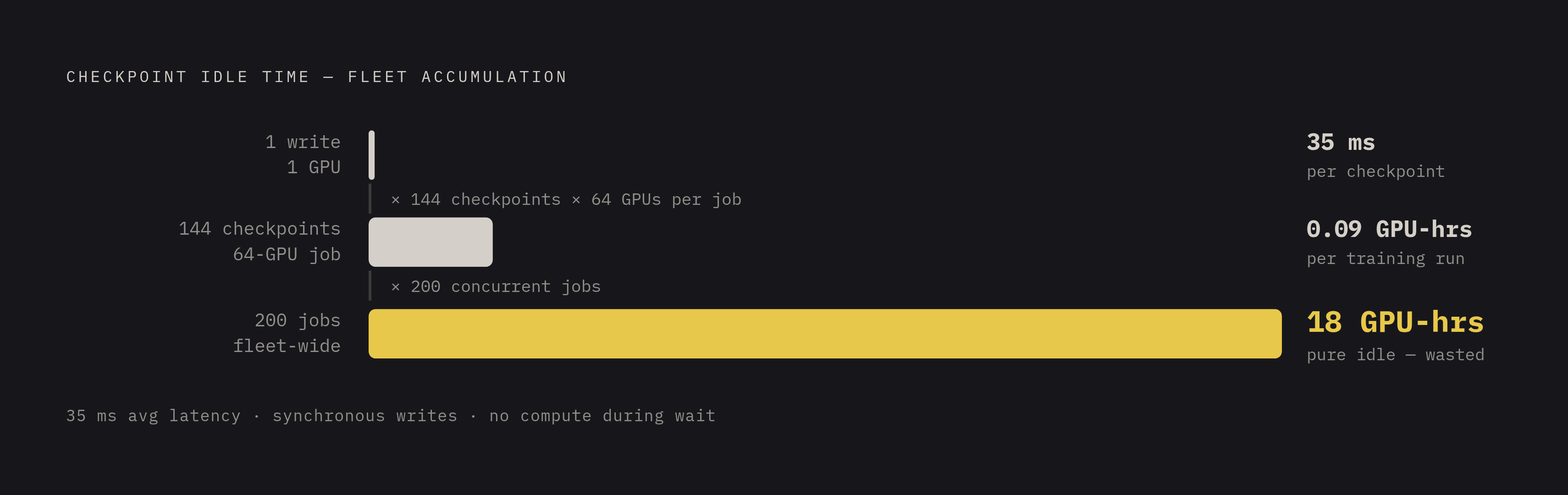
The cost isn't abstract, either. A checkpoint write to cloud object storage during an AI training run costs 30 to 40 milliseconds of latency per write, which sounds tiny until it gets multiplied. A platform running 200 concurrent training jobs, each chewing through a 64-GPU cluster, with 144 checkpoint events across the run, racks up roughly 18 GPU-hours of pure waste at 35 milliseconds of overhead per write. Eighteen hours of GPU time spent doing nothing but waiting for writes to complete.
Asynchronous checkpointing writes in the background while the work keeps moving, and it cuts that idle cost dramatically. But it demands storage that can absorb large burst writes without choking whatever else is trying to read from it at the same moment. Async is a lunch someone else is cooking while the work keeps going, and the kitchen still has to be big enough to handle it. It's a lunch someone else is cooking while the work keeps going, and the kitchen still has to be big enough to handle it.
Storage architecture for checkpoints: why the backend matters
Object storage has become the default home for AI checkpoints, and for good reason: it scales horizontally, handles massive parallel access, and fits how distributed training environments actually get built.
A tiering pattern has settled out in practice. Write first to storage local to the GPU, since that's the fastest write available. Copy asynchronously to a neighboring GPU's local storage next, so a fast restore sits close by. Only later does the checkpoint migrate out to shared storage for longer-term retention.
The economics are blunt. Object storage runs at roughly one-tenth the price of the faster tiers, so the whole tiering setup is a cost play wearing an architecture diagram as a disguise.
And the ceiling on how well this scales sits higher than most people assume. VAST Data, as reported in Blocks and Files, put a trillion-parameter model at 99.7% forward progress, meaning only 0.3% of total training time got lost to checkpointing overhead, running across 3,072 GPUs with a file system pushing 273 GB/s. That's checkpointing basically disappearing into the noise floor.
Recovery design: how agents wake up after failure
Writing the checkpoint is the easy half of this whole equation. Recovery is where the design holds up or falls apart, because a checkpoint nobody can actually use is just an expensive backup of nothing, sitting in storage, doing zero work.
Partial tool execution is the sharpest edge here, and most designs get it wrong. If a tool call was mid-flight when the process died, whatever wakes the agent back up needs to know: retry it, skip it, or flag the result as unknown. A checkpoint that saves model state but forgets tool execution state hands back a corrupted recovery: an agent that genuinely believes it finished something it never actually finished.
Databricks frames the underlying metric as "goodput," the share of GPU time spent on actual, productive computation, as opposed to time spent waiting around or clawing back from a failure. That framing applies just as directly to any long-running agent, where recovery latency is a straight subtraction from goodput, no exceptions and no exemptions for good intentions.
Industry telemetry on production AI environments puts average GPU utilization somewhere around 55% to 65%, and GPU starvation can drag utilization down to roughly 5% in the worst-case scenarios seen in production AI environments. Recovery time feeds that gap directly. Every second an agent spends figuring out what it was doing before it crashed is a second nobody gets back, and at scale, those seconds stack up into a number that earns its own line item in a budget review.