Object Storage Namespace Design for High-Throughput Filesystem Workloads
Naming your object storage keys wrong turns metadata into your bottleneck.
Sponsored by Archil
If you think the way you name objects in a bucket is a cosmetic decision, you're in for a rough time. The flat namespace you choose decides if a filesystem layer on top runs at near-local speed or crawls under load. This piece walks through exactly where that cost hides.
Object storage is a flat key-value space served over HTTP. A filesystem layer has to build directories, metadata consistency, and random access on top of that flat surface. Every open, stat, readdir, and rename becomes one or more object API calls. The namespace layout decides how many calls each operation needs and whether they can run in parallel. When an AI agent workspace or a code-execution sandbox stalls on metadata, the namespace is usually where the bottleneck was introduced. IBM's Vela paper describes Active File Management technology that surfaces objects as files on demand, and its correctness hinges on the key structure faithfully encoding the file namespace. That's not an implementation detail. It's the foundation.
How prefix structure and key depth drive metadata operation cost
The first place namespace design shows up in your bill is prefix depth. Drop every object under one flat prefix and you get a single LIST call that returns thousands of entries. That's fine for a sequential scan. It's a disaster when a random stat or open needs to find one file buried in that result set. You're paying to enumerate everything before you read the thing you actually want.
Nest prefixes deeply, mirroring a real directory tree, and you trade one problem for another. In naive implementations, opening a file at depth N means N ancestor LIST or HEAD calls before the object itself is fetched. Each prefix level adds latency. For those implementations the practical sweet spot is shallow: two to three levels keeps filesystem overhead bounded. Past that, latency compounds with every layer you add.
The delimiter choice interacts with LIST pagination too. Use / as the separator and a namespace where many keys share a long common prefix forces the store to scan and discard huge swaths of the keyspace before returning the prefix group you asked for. Your key naming scheme isn't just labels. It's a routing table the object store has to walk.
Why small-file density in a prefix group is the hidden multiplier on LIST latency
Even a sensible prefix hierarchy falls apart under small-file workloads. The ratio of LIST calls to bytes transferred explodes when every file needs its own metadata resolution. A directory with thousands of small files forces the filesystem layer to page through paginated LIST responses just to answer a single readdir. You're not paying for data movement. You're paying for the privilege of finding out what data exists.
AI agent workspaces are structurally small-file environments. A workspace holding cloned repos, config files, credentials, and intermediate outputs can easily contain tens of thousands of objects, most under a few kilobytes. IBM's Vela paper describes a 140 TB filesystem capacity acting as a read-write cache over petabytes of object storage. When that cache is cold, every file path has to be resolved through the object namespace. Small-file density is what determines how expensive that resolution gets.
The IGTCache research (arXiv 2506.12370) shows AI workloads have heterogeneous access granularities: large text corpus files next to individual small image, speech, and video files, plus multi-directory dataset trees. A single cache strategy misses throughput opportunity because it can't adapt to that granularity. Namespace design has the same problem. A prefix layout tuned for large sequential reads performs badly on the small-file random-access pattern agents actually produce.
Packing strategies offer one escape hatch. If you group small files into aggregate objects at write time (tar, zip, or custom container formats), LIST cardinality drops, but the read path must unpack on cache miss. That tradeoff only makes sense when read patterns are predictable. Agents rarely are.
How directory-to-prefix mapping strategies determine rename and consistency cost
Directory rename is where prefix-based mapping shows its teeth. Object stores have no native rename, so renaming a directory means copying every object from the old prefix to the new one and deleting the originals. That's O(N), where N is the number of objects in the subtree. For agent workloads that checkpoint state by writing to a temp path and renaming into place, this isn't a rare edge case. It's the core durability pattern, and it scales with workspace size.
You have three ways to bound that cost. An indirection layer maintains a metadata index mapping logical paths to object keys, so a rename updates the index rather than moving objects. You trade rename speed for added read-path lookup overhead. Content-addressed keys decouple keys from paths entirely, making the namespace a map from path to content address. Rename becomes O(1) in the index, but you need index consistency guarantees the object store doesn't provide natively. Prefix compaction limits subtree depth so any rename touches a bounded number of objects, which only works when the tree is shallow by design.
Consistency compounds the problem. Object stores historically offered eventual consistency on LIST after PUT or DELETE. Amazon S3 moved to strong consistency for all GET, PUT, LIST, and DELETE operations in December 2020, but some other and self-hosted stores may still behave the old way. A filesystem layer that renames by copy-and-delete can expose a window where both old and new keys are visible, or neither is, depending on when the read lands. Full POSIX semantics (atomic rename, flock, fsync) are requirements for the agent code patterns that matter. Checkpoints, workspace swaps, and file locking all depend on those primitives being honored.
Prefix isolation as the boundary between performance, security, and IAM design in multi-agent deployments
In a multi-agent deployment, the prefix hierarchy pulls triple duty: performance boundary, security boundary, and IAM boundary. Designing it to serve all three at once requires tradeoffs a naive layout ignores. Bucket-per-agent gives each agent a hard IAM boundary enforced by the object store itself. Bucket policies attach to buckets, so there's no risk of a misconfigured prefix pattern leaking one agent's data to another. Prefix-per-agent within a shared bucket is cheaper at scale but conflates IAM boundaries. A single overly broad bucket policy can grant access across agents, and prefix-level policies need careful, error-prone condition expressions. The tradeoff isn't purely cost either. LIST operations in a shared bucket aren't scoped by IAM at the prefix level in all implementations. An agent with bucket-level LIST permission can enumerate other agents' prefixes even if it can't read their objects.
Bucket-per-agent is less of a performance win than it looks. S3 scales request rates per prefix, so distinct per-agent prefixes already spread load, and bucket-per-agent is bounded by account bucket quotas. Shared-prefix designs work when agents share read-only data like a model checkpoint or reference dataset. A common read-only prefix with separate per-agent write prefixes captures the shared LIST caching benefit while keeping write isolation intact.
How branching and checkpointing patterns stress namespace design in ways steady-state workloads do not
Agent loops structured as search over a workspace (exploring multiple paths, rolling back to a checkpoint, forking a branch for a parallel hypothesis) impose write amplification and namespace mutation patterns that expose every weakness in a prefix-based mapping at once. Steady-state reads and writes don't prepare you for this. The BranchFS paper formalizes branching as an OS primitive: a filesystem layer giving each branch an isolated copy-on-write workspace with O(1) creation, atomic commit to the parent, and automatic sibling invalidation, all without root privileges. The insight is that cheap branching requires the storage substrate to support copy-on-write sharing natively, not simulate it by copying objects. The TClone paper extends this to live GUI workspaces via low-latency forking and separates branch creation from durable checkpointing. A branch becomes runnable through copy-on-write sharing without copying a single page on the critical path, while the durable image writes asynchronously.
The namespace implication is direct. Server-side copy (S3's CopyObject, GCS's rewrite) avoids moving bytes through the client, but it still copies every object; true copy-on-write branching needs a metadata layer that references shared objects. Encoding version or branch identity in the key prefix turns branch creation into a metadata operation only when that layer resolves unchanged paths to the parent's objects.
Checkpoint cost at scale runs between two extremes. The Crab paper identifies application-level recovery as cheap but missing OS-side effects, and full per-turn checkpointing as correct but expensive under dense co-location. The namespace design determines where a system lands on that spectrum. A namespace that tracks deltas by prefix rather than full snapshots can checkpoint only changed objects. Ad hoc workarounds agents currently use (git stashing, temporary directories, container clones) all impose object namespace churn that compounds with search depth. Each branch attempt that copies a subtree rather than referencing it burns object API quota and inflates LIST cardinality for every concurrent agent sharing the namespace.
Cache layer placement and prefetch granularity as the correction mechanism for namespace-induced latency
A cache layer between the filesystem interface and the object store absorbs the latency of expensive LIST and HEAD operations on cache hit. But its hit rate depends on whether the cache's prefetch and eviction strategies match the access pattern the namespace layout produces. Those patterns vary by workload type.
IGTCache demonstrates that AI clusters show heterogeneous access patterns simultaneously: sequential for inference, random for training, skewed for RAG and data augmentation. A single cache policy tuned for one pattern misses significant hit-rate opportunity on the others. The same heterogeneity applies to filesystem-over-object-store deployments where agents, training jobs, and data preprocessing pipelines share a namespace.
Prefetch granularity must match the object granularity encoded in the namespace. Block-level prefetch works for large sequential files but, per the IGTCache research, misses 78.3% of speedup opportunity for a ResNet testing workload where access isn't purely sequential. File-level prefetch suits small-file random access. A namespace that mixes both in the same prefix group forces the cache to guess, and guessing wrong is how you waste both cache space and latency budget.
IBM's Vela paper validates cache-over-object-store at production scale: a 140 TB filesystem capacity as read-write cache over petabytes of object storage, bringing data on demand and flushing writes asynchronously. Its performance depends on the object namespace correctly encoding the file hierarchy so on-demand fetches resolve without extra reconciliation calls. NVMe-backed cache tiers co-located with compute collapse cache-hit latency to sub-millisecond, making object store LIST latency irrelevant on hot data. But only for data that stays hot long enough to amortize the cold-miss cost. Namespace designs that scatter related files across prefixes reduce spatial locality and degrade prefetch effectiveness. The principle is simple: organize prefixes so the data an agent or pipeline accesses together is stored together. Then size the cache to the hot working set, not the total dataset.
The namespace design decisions that actually determine whether a filesystem layer scales
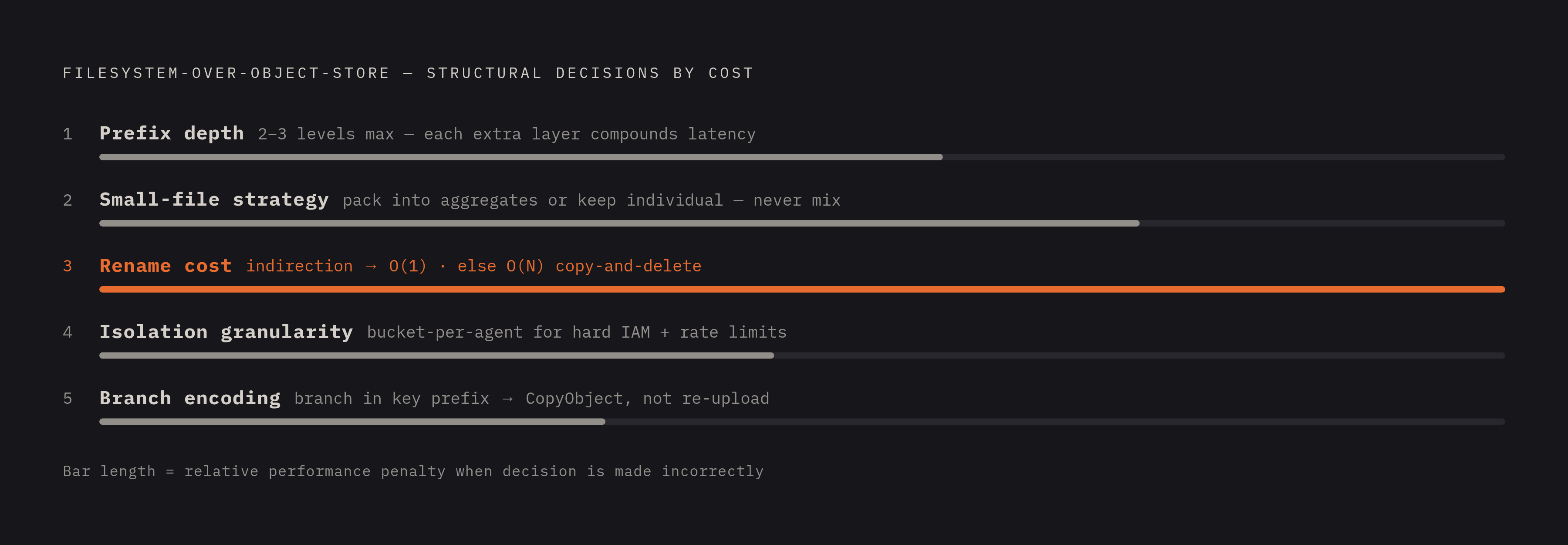
The namespace decisions that determine filesystem throughput at scale aren't the ones engineers spend time on. Naming conventions, case sensitivity, delimiter choice: those are bikeshedding. The structural choices that matter are the ones governing LIST cardinality, rename cost, branch amplification, and cache alignment. Five decisions do the heavy lifting.
Decision 1: prefix depth. If the filesystem layer resolves paths naively, keep the tree shallow, two to three levels, for general workloads. Add depth only where it maps directly to an access pattern boundary: per-agent, per-tenant, per-branch.
Decision 2: small-file handling. Decide at design time whether to pack small files into aggregates or treat them as individual objects. Mixing both in the same prefix group defeats cache prefetch and inflates LIST cost.
Decision 3: rename and atomic-update strategy. Choose an indirection layer or content-addressed keys if atomic rename is required. Accept O(N) copy-and-delete only for prefix subtrees bounded in size by design.
Decision 4: isolation granularity. Use bucket-per-agent for hard IAM boundaries, within account bucket quotas. Use prefix-per-agent only when a shared-data access pattern justifies it and IAM conditions are audited for prefix bleed.
Decision 5: branch and checkpoint encoding. Encode branch identity in the key prefix and let a metadata layer reference the parent's objects, so branching neither re-uploads nor server-side copies data. Separate branch creation from durable checkpointing so the critical path isn't gated on a full snapshot write.
For teams connecting existing S3, GCS, R2, or Azure Blob buckets to a filesystem layer without migration or ETL, these decisions aren't hypothetical. The existing key structure is the namespace, and the filesystem layer must perform against it as-is. A caching filesystem layer can mask some of these costs, but not rename semantics the key layout can't express.
This article is sponsored by Archil.